
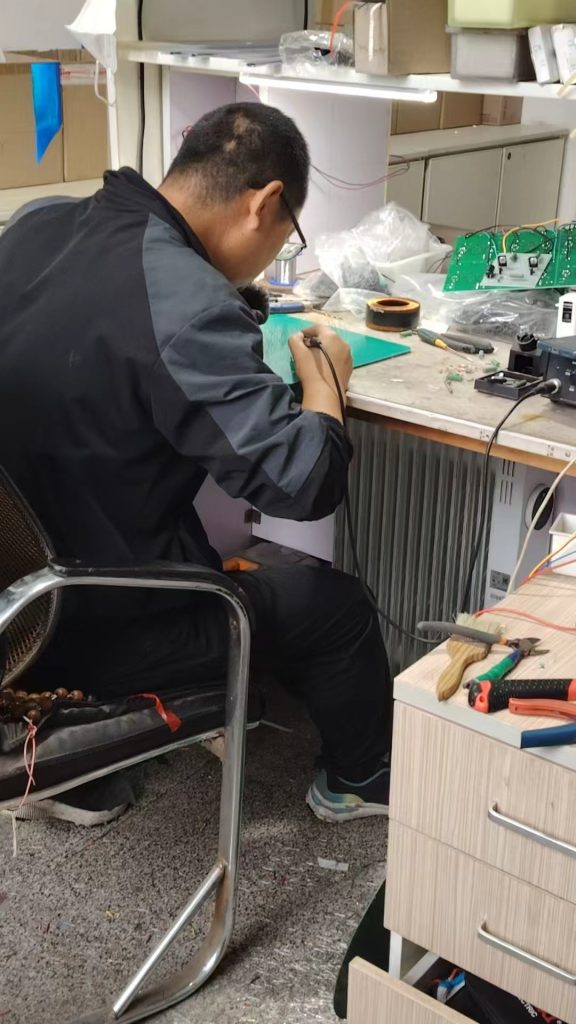
At the production facility of Weifang Changxun Traffic Engineering Co., Ltd., a team of skilled technicians is meticulously debugging a batch of centrally coordinated traffic signal controllers before they are dispatched for installation. The scene reflects the company’s commitment to precision and quality in intelligent traffic management.
“The signal system must be precise—absolutely no room for carelessness, because it directly relates to vehicle control and public safety,” says the lead engineer on the debugging floor. This philosophy drives every step of the process, from initial assembly to final testing.
The controllers being tested feature comprehensive fault self-diagnosis and operation monitoring capabilities. When the system detects anomalies—such as green conflict, red-green simultaneous illumination, or abnormal signal lamp current and voltage—it automatically downgrades to a safer operational mode, typically entering a yellow-flashing state, and records detailed fault information for later analysis. Under networked conditions, these controllers can actively report fault information back to the traffic control center, enabling rapid response and maintenance dispatch.
The debugging process involves rigorous checks of multiple control functions. Technicians verify the controllers’ ability to operate in various modes, including multi-period fixed-time control, networked coordinated control, cableless coordination for “green wave” corridor control, and induction control based on real-time traffic flow detection. The signal controllers support multiple vehicle detector types—including geomagnetic, microwave, inductive loop, laser, and video-based detection—and periodically collect traffic flow data to enable adaptive, actuated, and semi-actuated control strategies.
One of the critical features being tested is the smooth transition mechanism. “When control modes switch or timing plans change, the signal controller must achieve a smooth transition—no abrupt changes that could create safety hazards at intersections,” explains a senior technician monitoring the diagnostic display. This is particularly important when moving between manual override, special event control, and normal automated operation.
The controllers also undergo communication testing to ensure reliable data exchange with central management systems. Each unit must successfully upload key operational data—including signal controller parameters, detector status, lamp status, operational mode, coordination state, current timing plan, cycle length, and fault logs—while also receiving commands for plan updates, time synchronization, and emergency interventions such as full-red or yellow-flash commands.
The company’s debugging standards are shaped by years of experience serving diverse infrastructure needs—from bridges and highways to temporary barriers for marathons and concerts. The same signal controllers being debugged today may eventually coordinate traffic flows on a major highway bridge, or direct vehicles around a concert venue, or support safety protocols during a city marathon.
Each unit must pass a battery of functional tests covering multi-period timing, coordinated control, priority handling for emergency vehicles, and special scenario management. After completing the debugging phase, the controllers undergo final inspection before being deployed to projects across China and export markets.
From the technician’s workbench to the busy intersections they will one day manage, these traffic signal controllers embody the company’s dedication to safety, reliability, and intelligent transportation innovation.